;void(0); "Share on pinterest")


This gluten-free deep-dish peach pie is packed with ripe summer peaches and baked in a tender, buttery homemade crust. Warm ginger and a hint of orange complement the fruit.
Looking for something specific?


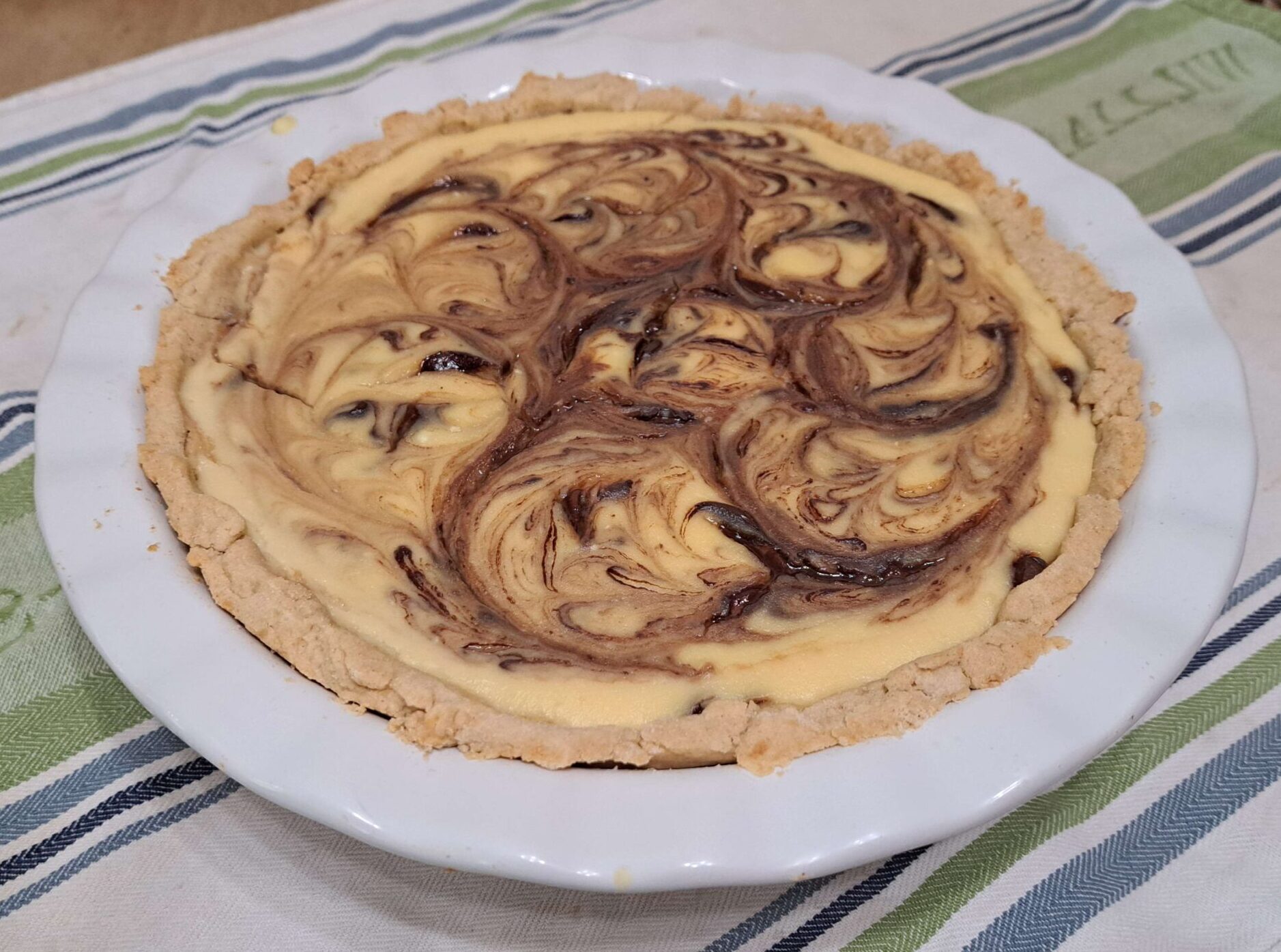
Beneath its buttery gluten-free crust lies an abundance of rich, creamy custard, gently warmed with rum and speckled throughout with chocolate chips. The rum deepens the chocolate, and the chocolate gives body to the rum. Together they turn a familiar vanilla custard pie into something especially luxurious.
Custard pie is my family's favorite variety of pie. And this decadent pie is right up there with my pumpkin and sugar cream pies. I pair the creamy filling with my reliable gluten-free pie crust for a delicious all-season pie.
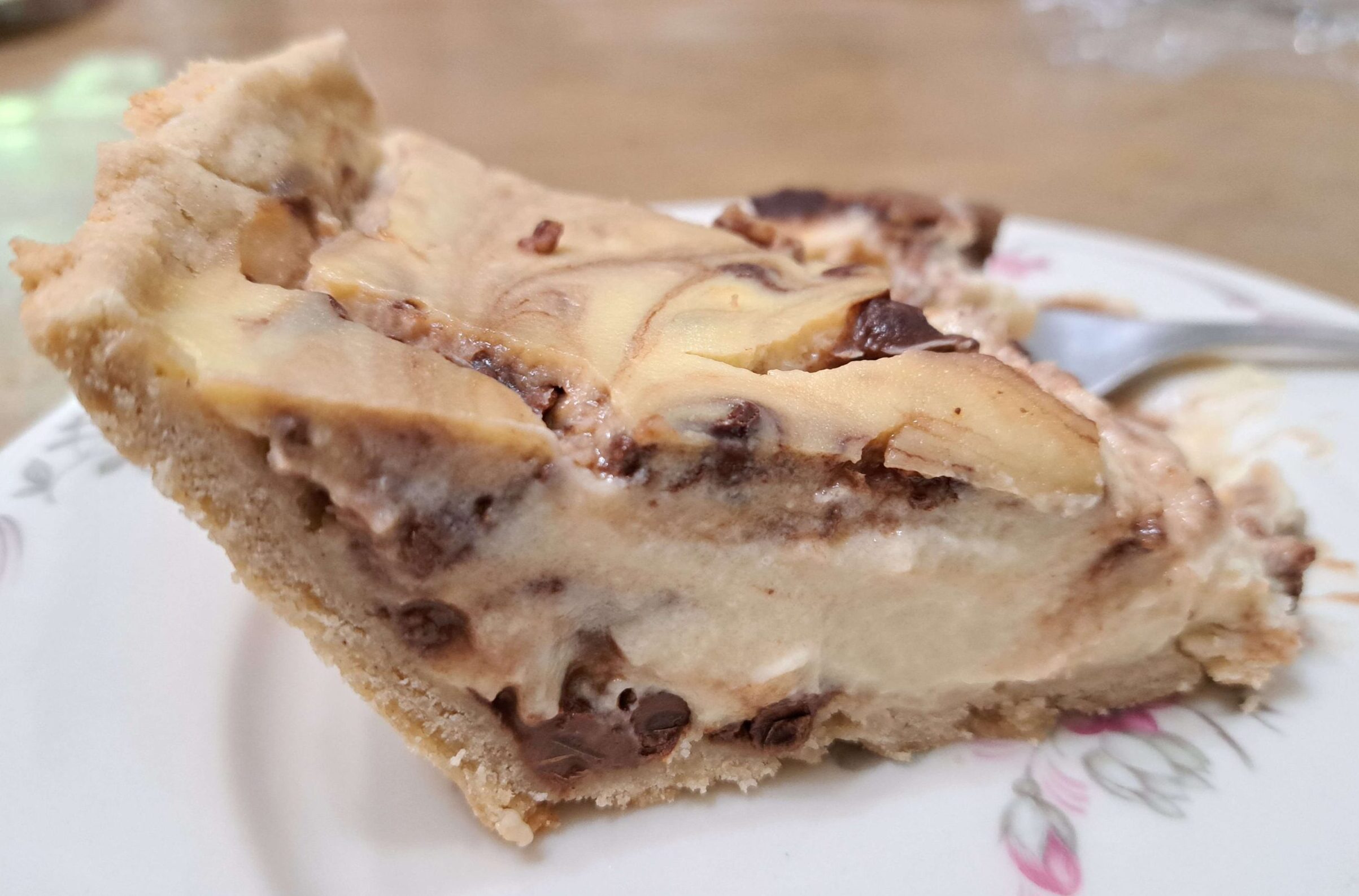
Unlike Sugar Cream Pie, or other traditional custard pies, this custard is cooked on the stovetop, completely separate from its crust. This method gives the baker better control over the crispness of the crust, as well as the set of the custard. It also makes it friendlier to summer baking, when a long bake time means heating up the house.
But it does introduce a few complexities. First of all, the crust - it needs to bake completely and then cool before adding in the filling. There is no second baking, as with some other custard pies, to ensure doneness. So follow the baking instructions on the crust recipe as though you were making any other no-bake pie. If you are using my pie crust recipe, make sure it is golden brown and a little puffy before taking it out of the oven.
Then the crust needs to be cool - or at least room temperature - before adding the custard. A warm pie crust filled with warm filling will create a mushy crust. It may also cause undue stress to the pie plate to put it in the refrigerator to let the filling set while the plate is still hot from the oven. So plan to make the crust an hour or two ahead of the filling; you can even make it the day before, and keep it in the refrigerator overnight.
The second thing to watch out for is that the custard cook adequately. Because brown rice flour is used to set the custard, it needs to reach the right temperature to set properly. If it does not, you will get a soupy pie, no matter how much time it has to cool. So make sure that the custard reaches boiling, and then bubbles for a minute or two on the stovetop.
(1) Prepare and bake your chosen pie crust according to its recipe directions. Allow it to completely cool before adding the custard.
My buttery gluten-free pie crust recipe goes wonderfully with this pie.
(2) Combine the milk, and rum in a medium saucepan. Heat over medium-low heat until the milk is steaming and small bubbles begin to appear around the edges. Do not let it boil.
Note: I add the rum early to burn off a little of the alcohol. If you do not want that effect, add it at the very end, before taking the custard off the stove.
(3) In a medium bowl, whisk the eggs and cream together until smooth and evenly blended.
(4) While whisking the egg mixture constantly, slowly pour in about 1 cup of the hot milk from the stove. Gradually whisk the tempered egg mixture back into the saucepan. This gentle warming helps prevent the eggs from curdling.
(5) In a separate bowl, whisk the dry ingredients together thoroughly, breaking up any lumps.
(6) Gradually whisk a small amount of the warm custard mixture into the dry ingredients until completely smooth. Pour this mixture back into the saucepan, whisking as you pour.
(7) Cook over medium-low to medium heat, whisking constantly and scraping along the bottom and corners of the pan. Once the custard has thickened and begun to bubble gently, continue cooking and whisking for 1 minute. Add your vanilla extract, and then remove the custard from the heat. If you reserved the rum and vanilla, stir them in now.
(8) Sprinkle a layer of chocolate chips over the bottom of the cooled crust. Spoon or pour some of the hot custard over the chocolate, then add another scattering of chocolate chips. Continue layering the custard and chocolate until the crust is filled, finishing with additional chocolate chips if desired.
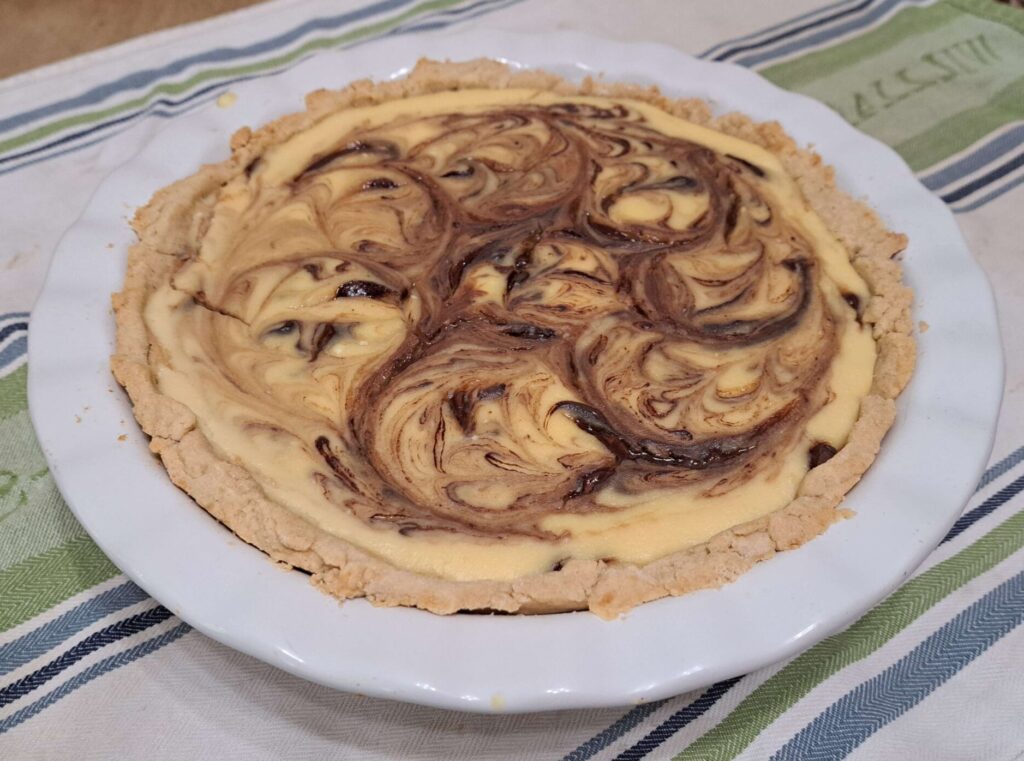
(9) Allow the chocolate to soften in the hot custard for a minute or two. Drag a thin knife or skewer gently through the filling to create swirls, taking care not to overmix - the goal is to leave distinct ribbons and speckles of chocolate.
(10) Let the pie cool briefly at room temperature, then cover and refrigerate until completely cold and firm - at least 4 hours and preferably overnight. Keep refrigerated until ready to serve.
Note: this is a deep dish pie recipe. If you are not using a deep dish pie plate, then halve this recipe.
As pies go, this one is surprisingly convenient. The crust bakes in about 25 minutes, and the filling comes together in roughly the same amount of time. You will need to allow several hours for the pie to cool and set - preferably overnight - but that makes it an excellent make-ahead dessert. The custard only improves as it chills and rests.
One important note: this recipe makes a deep-dish pie. If you are using a standard pie plate, halve the custard recipe or divide the full batch between two crusts. Store-bought gluten-free pie crusts are often fairly shallow and may hold only half as much filling as a deep-dish pie plate.
Rum is a critical part of the flavor profile of this pie, and rum as a spirit contains a decent amount of alcohol. Specifically, the brand I recommend - Old Monk - contains 42.8% alcohol. That said, the recipe only calls for ⅛ cup. And assuming you cut your pie into eight slices, each slice only contains ¾ teaspoon of rum (give or take).
That is a very small quantity of alcohol. But should you want a mellower rum flavor (or a little less alcohol content) add the rum at the beginning with the milk. Alcohol boils, and thus evaporates, at a much lower temperature than water - approximately 173°F. So a little bit of the alcohol should evaporate off as the custard bubbles.[source]
That said, it is always impossible to know exactly how much alcohol evaporates during cooking, short of having your food tested in a lab. So assume this will remain a boozy dessert.
If you need to avoid alcohol entirely, you can try a zero proof rum alternative. I have not tested nonalcoholic spirits in this recipe, however, so I cannot vouch for their flavor or performance.
For the boldest, most aromatic rum flavor, stir the rum into the custard near the end of cooking. You can also split the difference by heating most of the rum with the milk, then adding a small splash at the end. Likewise with the vanilla, for the best flavor and aroma, add it at the end right before taking the custard off the heat.
I used Old Monk Dark Rum while testing this recipe, and I cannot recommend it highly enough. Old Monk is an Indian dark rum made from molasses and matured in oak barrels for at least seven years. Its rich notes of caramel, chocolate, and vanilla make it an especially natural match for the flavors in this custard.[source]
Many alcoholic drinks promise notes of caramel, vanilla, or some other dessert-like flavor, only to taste nothing of the sort - at least to me. Old Monk actually is deliciously sweet, like the sugar cane it was made from. The rum gives the pie a warm, dark sweetness that supports both the vanilla custard and the chocolate swirled throughout it.
I have found Old Monk at several liquor stores near me, but any flavorful dark rum should work well in this recipe. Look for one with prominent notes of molasses, caramel, vanilla, warm spice, or chocolate. I would avoid white rum, which generally has a lighter flavor and will not give the custard quite the same depth. A spiced rum may also work, but it will introduce its own blend of spices and could noticeably change the character of the pie.
This recipe calls for pricking the bottom of the crust with a fork to help it remain flat as it bakes. I find that this is usually enough to prevent the crust from puffing up excessively. If your crust tends to bubble or you simply want to play it safe, however, you can bake it with weights instead.
Ceramic pie weights hold the crust firmly against the pie plate while it bakes. Line the unbaked crust with parchment paper, then fill it evenly with the weights before placing it in the oven. For the best support, spread the weights across the bottom and up against the sides rather than concentrating them in the center.
Dried beans make an inexpensive alternative. Once they have been used for baking, they will no longer cook properly for eating, but you can cool and store them to reuse as dedicated pie weights.
A more unusual option is "pie armor," essentially the chainmail equivalent of traditional pie weights. It works in much the same way: place parchment over the crust, then lay the stainless-steel mesh on top. Because it comes out in one piece - and because it is, delightfully, chainmail - it may be more convenient and certainly more memorable than a container full of ceramic beads.
Any time you have to add eggs to a hot mixture, it can get tricky, and this custard is no exception. The goal is to use the eggs to thicken the custard filling, and add richness, without the eggs scrambling and turning lumpy.
But why do eggs scramble, anyway?
When eggs heat, their proteins begin to bond together. If they heat too fast, or without enough dilution, then the proteins bind very tightly. That creates rubbery lumps - not the smooth custard we are going for. The answer is gentle, gradual heating; the slow rise in temperature creates the fine protein structure we want for pie filling.[source]
This is why the tempering step is so important. Instead of pouring cold eggs directly into a saucepan of hot milk, slowly whisk some of the steaming milk into the eggs and cream. This dilutes the egg proteins and raises their temperature gradually. Once tempered, the eggs can be returned to the saucepan without undergoing the sudden temperature change that is most likely to scramble them.
After the eggs return to the saucepan, moderate heat and constant whisking remain essential. Keep the whisk moving across the bottom and into the corners of the pan, where the custard is most likely to overheat. The starch and sugar provide a little extra protection by interfering with the egg proteins as they bond, but the custard can still curdle if it becomes too hot or sits unstirred against the bottom of the pan. And if it doesn't curdle, it could certainly burn - so keep stirring!
If you do notice a few tiny bits of cooked egg, all may not be lost. Remove the custard from the heat and immediately pour it through a fine-mesh strainer. This can rescue a slightly lumpy custard, although it cannot fully repair one that has badly curdled. The best defense is simply to follow the slow-and-steady process in the instructions: steaming rather than boiling milk, gradual tempering, moderate heat, and plenty of whisking.
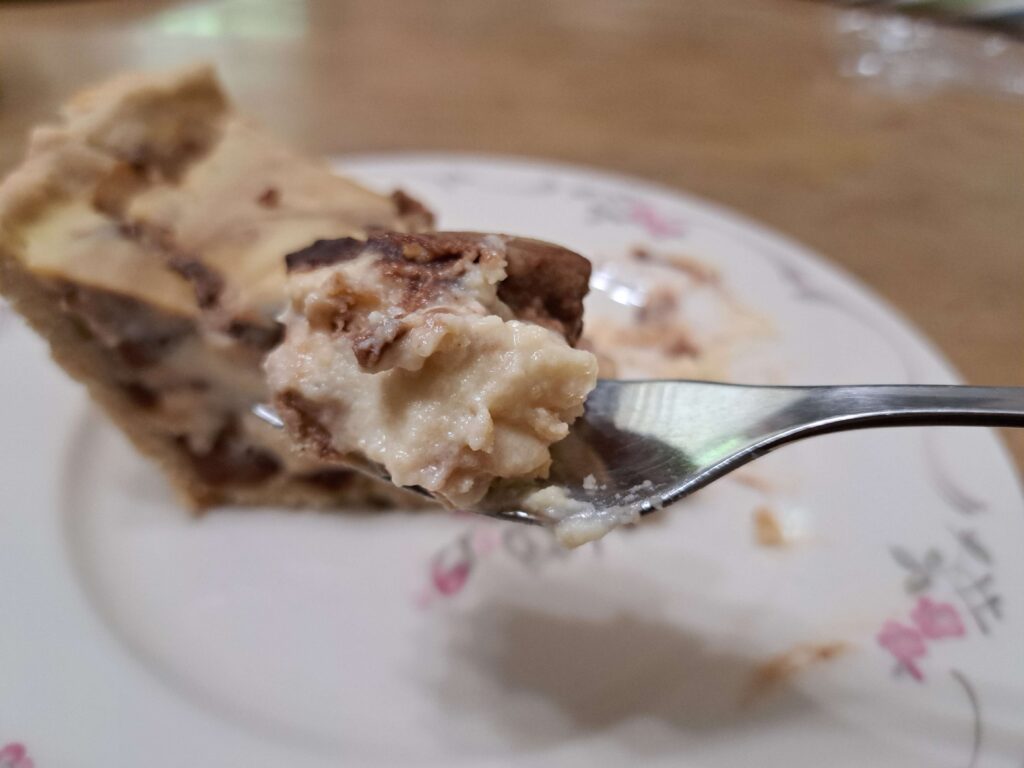
The chocolate chips make this pie especially easy to decorate. After layering them with the hot custard, drag a thin knife or skewer gently through the filling to create delicate chocolate swirls. The chips will soften quickly in the warm filling, so you should have plenty of time to play with the pattern. A few passes are enough; too much stirring will blend the chocolate into the custard rather than leaving distinct ribbons and speckles. Finish with a small scattering of chocolate chips on top, if desired, before allowing the pie to chill and set.
You can also dress up the crust before baking. Flute the edge with your fingers, press in a simple pattern with the tines of a fork, or decorate it with small cutouts made from leftover dough. Keep the design fairly simple so that the rich, swirled filling remains the star - and the pie slices remain easy to remove from the pie plate. Once chilled, the glossy swirls and speckles of chocolate will make every slice look just a little different.

Yes! Though I prefer making my own crust, a store bought crust will work in a pinch.
Just keep in mind that this recipe makes enough filling for a deep dish pie. If your store bought crust is "regular" size, then you will need to either:
Most likely, your filling did not cook long enough. The brown rice flour does most of the heavy lifting in thickening this custard, and it requires a few minutes of cook time at boiling in order to do its job.
Make sure to heat your custard until it starts to bubble, and then allow it to cook for at least a full minute, stirring regularly.
The tempering process - adding the cup of hot milk from the stove to the eggs before pouring them into the milk on the stove - is what helps protect against scrambling.
For more information, check the recipe notes.
~4 hours.
The longer this pie is allowed to chill and set in the refrigerator, the more it will hold together (and the better it will slice). I recommend allowing it to chill overnight, but if that is not an option, allow at least 4 hours.
No. While cooking can reduce alcohol content, you should never assume it removes it completely.
For more information, check my recipe notes. I also recommend this article on how much alcohol burns off during cooking or baking.
Yes! This pie will benefit from being made a day or two ahead of time, because it needs time to set in the refrigerator.
Just cover it with plastic wrap, and it should keep for up to 4 days.
Yes, you could use a non-alcoholic rum substitute instead of rum. But I have not tested any non-alcoholic spirits with this recipe, and so cannot recommend it.

Custard pies have a long family tree, stretching back to the Middle Ages. The Forme of Cury, a collection compiled by the cooks of King Richard II in the 14th century, contains several custard recipes - including one for a dish called "daryols." These were made with cream (or almond milk), eggs, and sugar, flavored with saffron, and baked in a "coffin" (read: pie crust):
Take Creme of Cowe mylke. oþer of Almandes. do þerto ayren with sugur, safroun, and salt, medle it yfere. do it in a coffyn. of II. ynche depe. bake it wel and serue it forth.[source]
Or in more modern English:
Take cream or almond milk, add egg with sugar, saffron and salt. Mix it up. Pour it in a two-inch deep pastry case. Bake it well and serve.[source]
In other words: custard pie. The basic idea has changed remarkably little in more than six centuries. The flavorings in this rum-vanilla custard pie with chocolate chips, however, tell a much newer - and decidedly New World - story.
Vanilla and chocolate both come directly from the Americas - specifically South America. Vanilla beans are the cured pods of a climbing orchid that grows from southern Mexico into northern South America, while chocolate begins with the seeds found inside the pods of the cacao tree, native from Costa Rica southward into tropical South America. Rum joins the story by way of sugarcane. The plant itself did not originate in the Americas, but the invention of modern rum - and much of its complicated history - is deeply entwined with the colonies and sugar plantations of the New World.

Vanilla has the strange reputation of being boring or cheap. The black bean - most commonly kept as an extract or seen as only the tiniest of black specks in an overall white dish - is not as exciting as the dark and decadent "chocolate." But real vanilla belongs in the same rarefied company as saffron: precious, labor-intensive, and quite exquisite.
Vanilla beans are the cured seedpods of climbing orchids in the Vanilla genus. Long before the arrival of the Spanish, Indigenous peoples throughout the orchid's native American range harvested and used its fragrant pods. The Totonac people became especially associated with vanilla, while Nahua sources describe tlilxochitl - the "black flower" - as a perfume, medicine, and flavoring for their chocolate drinks. The Spanish introduced vanilla to Europe in the 16th century, beginning its worldwide use.[source]
Vanilla itself traveled easily enough. Its pollination system did not. The orchid would grow and flower in other tropical regions, but without the ecology of its native range, it rarely produced pods. Botanists eventually learned to pollinate the flowers artificially, but the fast, practical method that transformed vanilla cultivation was devised in 1841 by Edmond Albius, a twelve-year-old enslaved boy living on the French island of Réunion. After learning how watermelon flowers were fertilized, Albius worked out how to lift the tiny membrane separating the male and female parts of the vanilla flower and press them together by hand.[source]
That deceptively simple technique allowed vanilla production to spread far beyond Mexico. Réunion developed a thriving vanilla industry, followed by its much larger neighbor Madagascar, which now dominates world production. Albius received neither wealth nor much recognition during his lifetime, but his discovery shaped the entire modern vanilla trade.[source]
Remarkably, vanilla flowers are still pollinated one by one, by hand, across most of the vanilla-growing world. The resulting pods must then pass through a long curing process before they develop the deep fragrance we recognize as vanilla. All that work makes real vanilla one of the most expensive spices in the world. Yet, like saffron in the Middle Ages, it is added to absolutely everything. Baking cookies? Add vanilla extract. Making ice cream? Bring out the vanilla bean. Chocolate cake? Add a teaspoon of vanilla; it will make the cake taste even better.
That last pairing is nothing new. Nahua chocolate makers were flavoring cacao with tlilxochitl centuries before either ingredient reached Europe. Vanilla and chocolate have been keeping company for a very long time.

Chocolate begins with cacao, another gift from the tropical Americas. The seeds of the Theobroma cacao tree were cultivated and consumed by Indigenous peoples long before the arrival of Europeans - but their uses were very different from what we know as chocolate today. They had a "decadent" reputation to be sure; the beans were used as currency, accepted as tribute, and were used to make a drink that was associated with the wealthy and powerful.[source] But that drink was not the sweet hot chocolate of modern day.
Among the Aztecs, and other tribes of Mexico, cacao was ground and then poured into a frothy bitter drink. The Florentine Codex describes an astonishing assortment of cacao drinks - red, black, white, honeyed, and flavored with "tender vanilla" - served in decorated gourds.[source] Chocolate could be served hot or cold, and flavored with any number of local ingredients, including chili, vanilla, and honey. The whisking created a distinctive foamy top.
Newcomers to Mexico commented upon how bitter the drink was by European standards, but the Spanish colonists as a whole loved it. Jose de Acosta, writing in 1598, said of chocolate:
"..it is the most prized drink and is offered to noblemen as they pass through [Indigenous tribes'] lands. Both Indians and Spaniards, and especially Spanish women who have grown accustomed to the land, adore their black chocolate."[source]
The Spanish carried chocolate across the Atlantic, where it remained primarily a drink for several more centuries. In Europe, the traditional preparation was combined with Old World spices and sweeteners. A Spanish recipe published in 1631 combines cacao not only with vanilla, chili, and traditional Meso-American herbs, but also with cinnamon, anise, and a hefty quantity of sugar.[source] By the later 17th century, fashionable "chocolate houses" had appeared in European cities, and in the 19th century new machinery and manufacturing techniques finally transformed chocolate from a luxurious drink into the bars, candies, and baking chocolate we recognize today.[source]
For our purposes, however, the most important transformation came much earlier: chocolate was introduced to sugar. Sugarcane was an Old World plant, but European colonists cultivated it on an enormous scale in the tropical Americas. Here it became not only a companion to chocolate, but also the foundation for another ingredient of this pie: rum.

Rum begins with sugarcane, which is a type of grass native to Southeast Asia. (It's actually a close cousin of sorghum: - another tall, jointed grass, this one better known for flour than syrup.) That's a strange starting point for a drink so thoroughly identified with the Caribbean - but sugarcane had a long journey ahead of it before it ever met a still.
The sugarcane grown today was first domesticated around New Guinea some eight thousand years ago, then carried westward into Southeast Asia, China, and India.[source] Ancient observers noticed its unusual sweetness early on. One of the oldest surviving accounts comes by way of Nearchus, a general under Alexander the Great who marched through the Indus Valley around 327 BC. Nearchus's own writings didn't survive, but the geographer Strabo preserved his report a few centuries later, describing reeds in India that "produce honey, although there are no bees."[source]
That fermenting didn't take long to catch up, though. By around the 3rd century BC, the Arthashastra - an ancient Indian treatise on statecraft - was regulating a whole menu of liquors, taxes and all, including one listed simply as "spirit distilled from molasses."[source] So the honey-like reed, the fermented drink, and even something resembling a very early proto-rum, all show up in the historical record remarkably early. But we are still a very long way from modern rum.
It was the secret of granulated sugar, not alcohol, that traveled out of southeast Asia. In India, they discovered how to boil cane juice down into crystallized sugar - something sturdy enough to store, ship, and sell, rather than something you had to drink on the spot within earshot of the fields. That knowledge from India into Persia, then spread across the Islamic world and into the Mediterranean. But sugar took its time reaching Europe proper, and even once it arrived, it stayed a luxury for centuries - sold by the ounce alongside spices like pepper and cinnamon, not stocked in every kitchen the way it is now.[source]
Then came the Age of Exploration, and with it, an entirely new scale of ambition. Sugarcane was already growing on Spanish- and Portuguese-controlled islands off the coast of Africa - the Canaries, Madeira - so when European ships started crossing the Atlantic, cane came along almost as a matter of course. Columbus planted it on Hispaniola in 1493, during his second voyage. It was a modest start. What came next was not.

Photo by jaikishan patel on Unsplash
Portuguese Brazil is where sugar stopped being a garden crop and became an industry - the first place in the New World where production scaled up into a massive, slave-powered plantation system. By the 17th century, that same brutal model had spread across the Caribbean, to islands like Barbados and Jamaica, as European colonists seized land and forced millions of enslaved Africans into the grueling, often deadly work of planting, cutting, and processing cane.[source]
All that sugar came with a byproduct - and it turned out to be nearly as valuable as the sugar itself, if you knew what to do with it. As cane juice was boiled down and crystallized, it left behind a thick, dark syrup: molasses. On its own, molasses was worth less than refined sugar. But it was still loaded with fermentable sugars, and in the Caribbean, that sticky leftover became the raw material for an entirely new commodity in the Atlantic world: rum.
Rum was likely first distilled for local use by the enslaved population of Barbados, sometime around the 1650s.[source] But it didn't stay local for long. It was cheap, it was easy to ship, and - as colonists quickly figured out - it was extremely profitable. Sugar, and the rum made from its leftovers, were about to become two of the most valuable commodities in the entire Atlantic world.
That value didn't stay contained to the Caribbean for long. By the early 18th century, rum and molasses had become one leg of what's now known as the "triangular trade" - a brutal, three-way exchange linking Africa, the Caribbean, and the American colonies. New England distillers, especially in port cities like Boston and Newport, bought Caribbean molasses by the barrel and turned it into rum. That rum sailed to West Africa, where it was traded for enslaved men, women, and children. Those who made it across the Atlantic alive were sold into the plantation system on the Caribbean sugar islands, and put to work producing more sugar and molasses - closing the loop, and starting it right back up again.[source]
Rum became so central to the colonial economy that Britain moved to tax it - first with the Molasses Act of 1733, then the tougher Sugar Act of 1764. Colonial merchants simply smuggled around both. The resulting friction over sugar, rum, and taxation fed some of the same grievances that would eventually boil over into the American Revolution.[source]
It's a lot of history for a dessert, isn't it? An orchid painstakingly pollinated by hand. A bitter drink once reserved for Aztec nobility. A byproduct of one of the most brutal economic systems the Atlantic world ever built. None of that sounds like it belongs anywhere near a pie crust.
But that's exactly the thing about food: it never carries just flavor. It carries everywhere the flavor has been. Every cuisine on earth is, in some sense, a history book you can eat - a record of who grew what, who traded with whom, who was forced to labor for whom, and who eventually sat down together (or didn't) to share the results. Vanilla, chocolate, and rum happen to be an unusually vivid example of that. Trace any one of them back far enough, and you don't just find a plant: you find empires, ingenuity, exploitation, and, eventually, somebody's kitchen. That's not a reason to look away from where these ingredients came from. If anything, it's the opposite: paying attention to that history is part of what makes eating well feel like more than just eating.
And it's worth saying plainly - these are not humble ingredients. Real vanilla is still, to this day, pollinated one flower at a time, by hand, because we've never found a better way to do it. Chocolate was once valuable enough to spend like currency, and to this day requires a massive amount of labor to grow and process into bars and candy. Rum was born from a byproduct nobody thought was worth much, and turned into one of the most consequential commodities in Atlantic history. Put plainly, this pie is stacked with three of the most storied, labor-intensive, quietly luxurious ingredients in the human diet. And most of us keep them in the pantry without giving them a second thought!
So give them a second thought. Then preheat the oven.
This gluten-free deep-dish peach pie is packed with ripe summer peaches and baked in a tender, buttery homemade crust. Warm ginger and a hint of orange complement the fruit.
The creamiest custard pie you will ever taste, in a gluten free crust. Enjoy warm from the oven, or chilled the next day.
Think pumpkin, warm spices, custard, and a dollop of whipped cream - isn't that the taste of fall? This gluten free pumpkin pie recipe will let you conjure that fall feel any time of year!