


Deep-dish rum-vanilla custard pie is pure, unapologetic decadence. Rich custard, flavored with dark rum and real vanilla, is speckled with chocolate chips and baked inside a buttery gluten-free crust.
Looking for something specific?


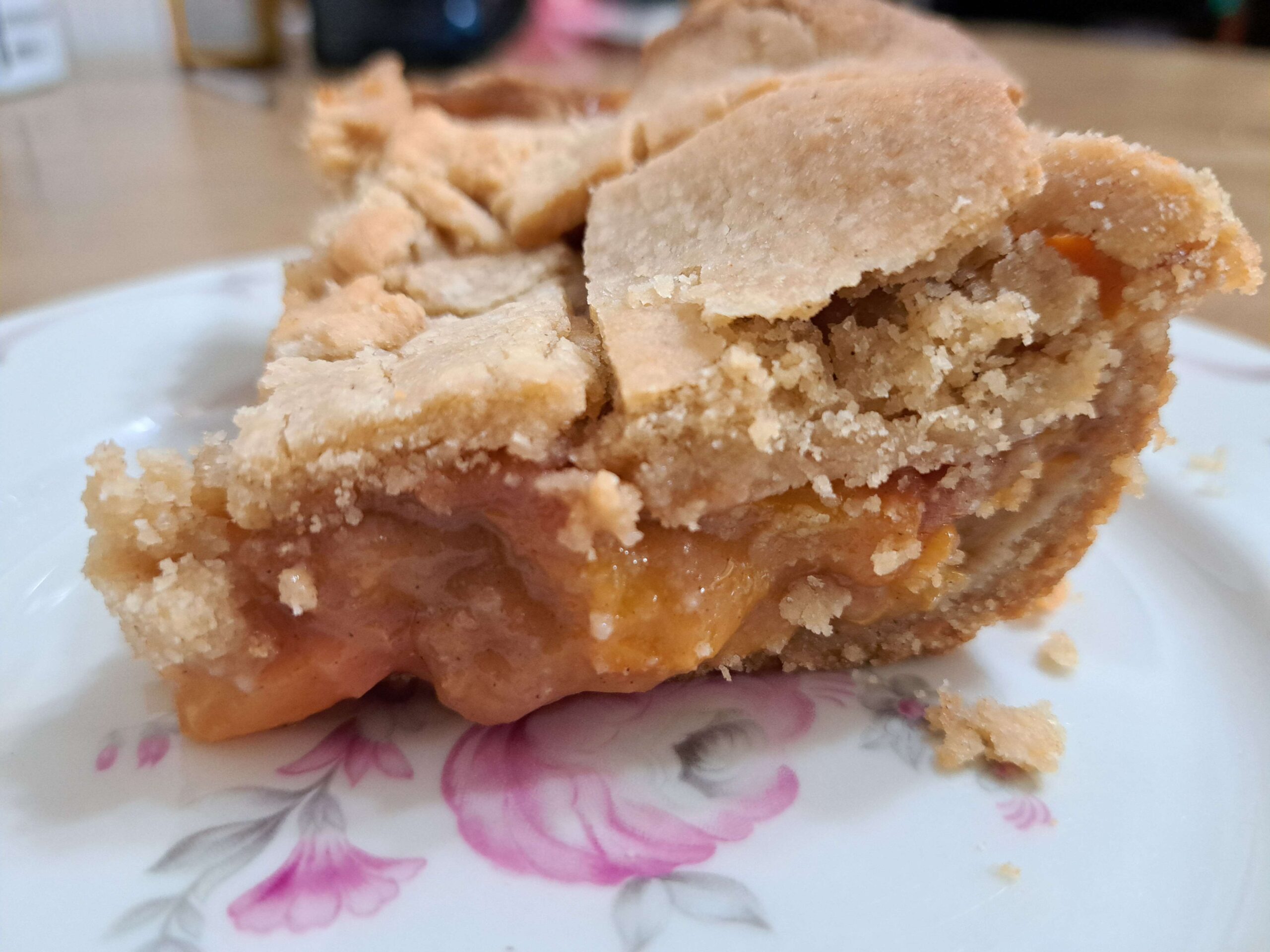
When I was a little girl, I was obsessed with peach pie - specifically cold peach pie. There is something so good about a deep-dish pie packed with fresh, ripe peaches. I have never eaten an entire pie by myself, but when it comes to peach pie, I feel like I could.
This pie's filling celebrates the sweet, sun-ripened flavor of fresh peaches, with warm ginger and just a whiff of orange. I still love a cold slice on a hot summer afternoon, but this pie is every bit as delicious served warm with a melting scoop of vanilla ice cream alongside it.
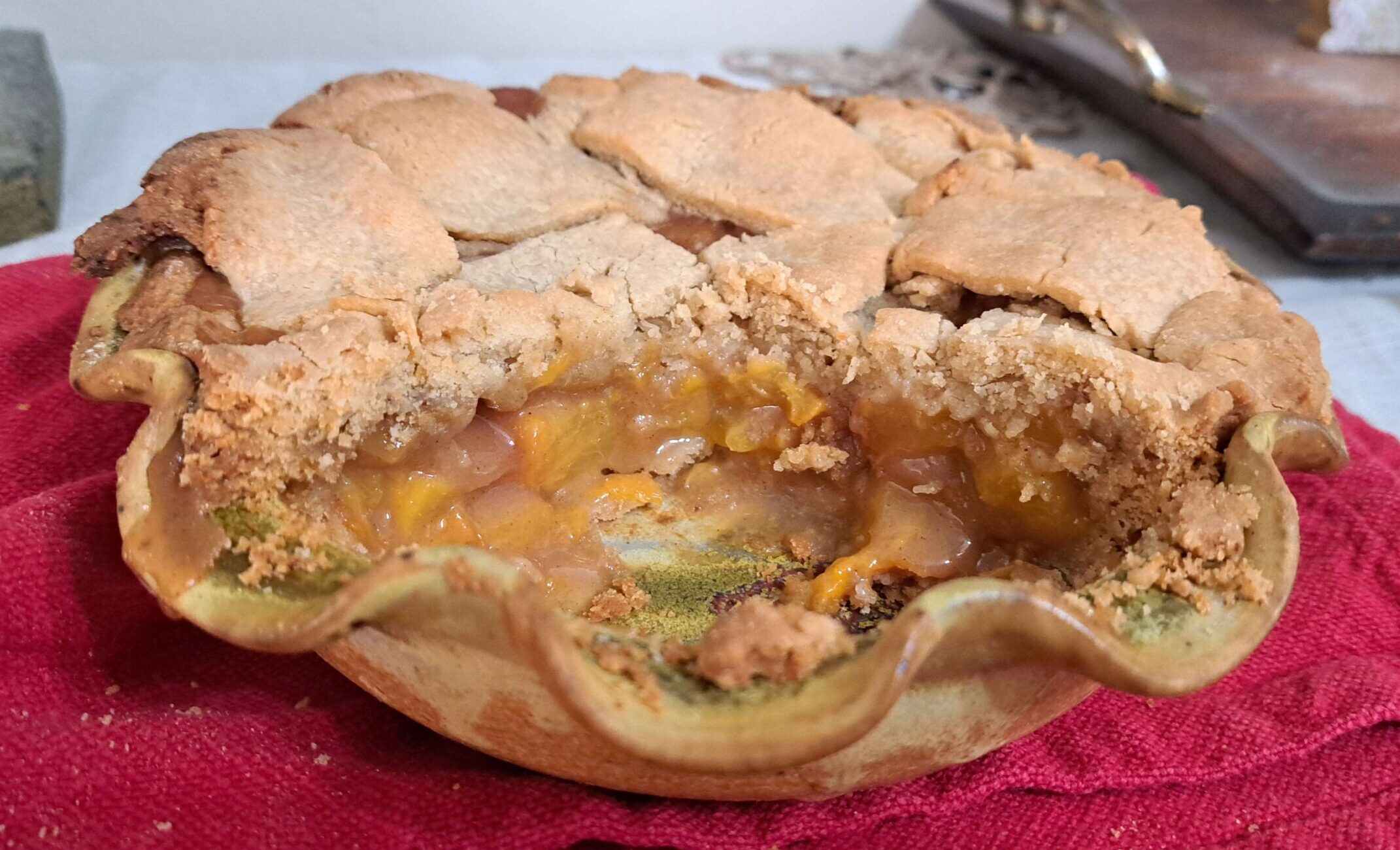
My buttery gluten-free pie crust complements the peaches beautifully. It is tender, easy to work with, and sturdy enough to hold all that juicy deep-dish filling: everything a homemade summer pie crust ought to be.
And this really is a deep-dish pie. Fresh peaches cook down considerably in the oven, so it takes a generous amount of fruit to produce a pie that still feels full and abundant once baked. Draining the sliced peaches first helps keep all that fruit from making the bottom crust soggy.
If you don't have a deep dish pie dish (first of all, why not?), then cut down the total number of peaches used to ~8.
The star of this recipe is fresh summer peaches, and peach flavor should be what really stands out. The cinnamon, ginger, and orange are simply enhancements.
I find that adding half the ginger to the pie crust gives it a little bit of warmth, and ties the crust and the filling together. The cinnamon and ginger in the filling just give the peaches a hint of complexity. And the orange zest should really just be a whiff - don't zest a whole orange into the filling, or it will turn out bitter.
;void(0); "Share on pinterest")
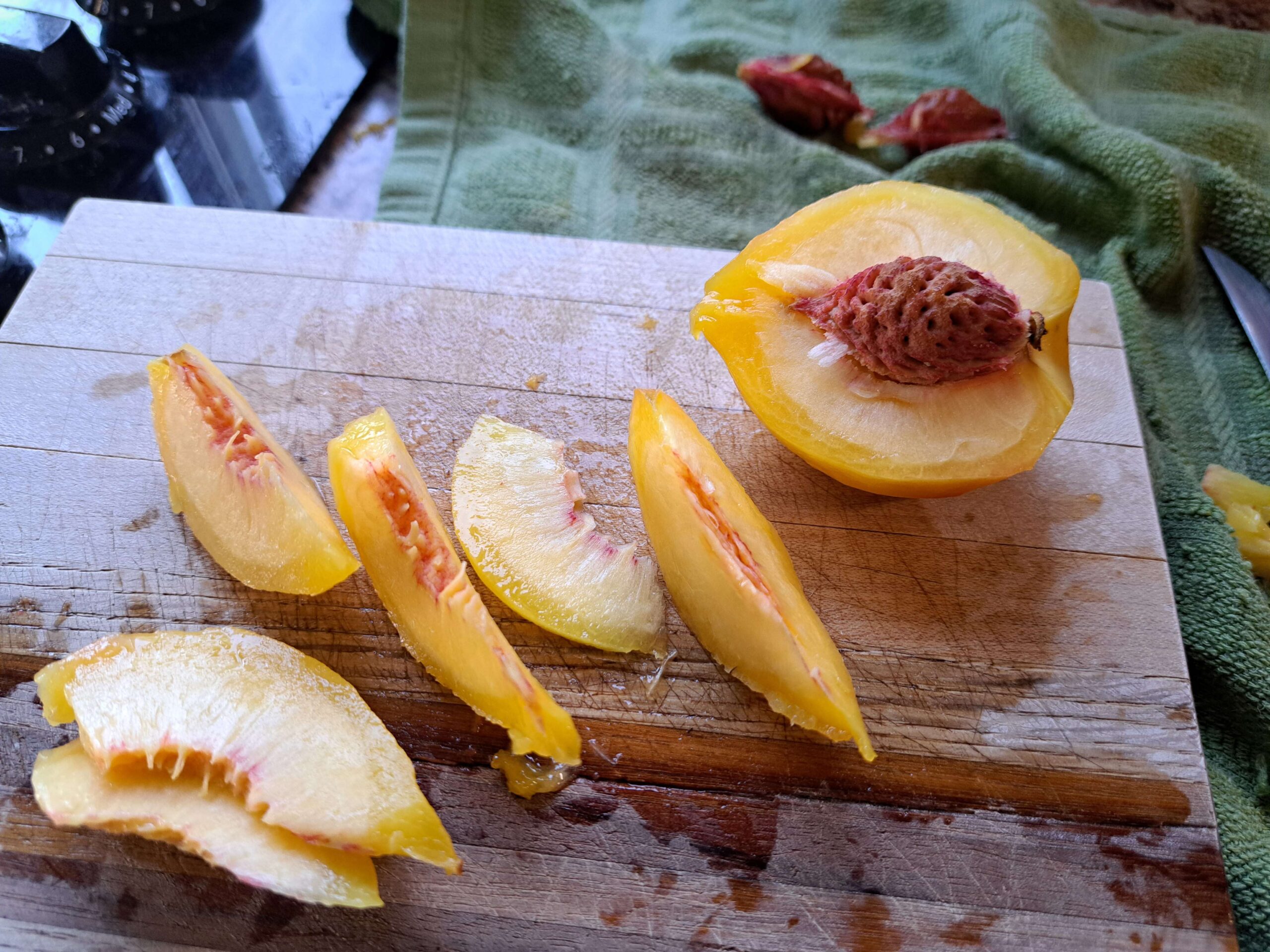
(1) At least two hours before you plan to bake the pie, prepare the peaches. Cut them into approximately ¼-inch slices and place them in a colander to drain. If you are baking the pie the same day, leave them to drain on the counter; otherwise, place the colander in the refrigerator.
Note: you can peel your peaches, or leave their skins on for a rustic pie. See the recipe notes for more information.
(2) Preheat the oven to 400°F.
(3) Prepare the gluten-free pie crust, adding ¼ teaspoon of ginger to the dough before rolling it out.
(4) Roll out half of the pie dough between two sheets of parchment paper to form the bottom crust. Transfer it to the pie plate and prick the bottom several times with a fork. Par-bake for 10 minutes, until the crust is slightly puffed and just beginning to brown.
(5) While the crust is par-baking, combine the drained peaches, brown rice flour, sugar, cinnamon, ginger, orange zest, and salt in a large mixing bowl. Toss until the peaches are evenly coated. There should be very little juice, if any, remaining in the bottom of the bowl.
(6) Spoon the filling into the par-baked crust. Dot the peaches with small pieces of butter, tucking a few pieces beneath the surface of the filling.
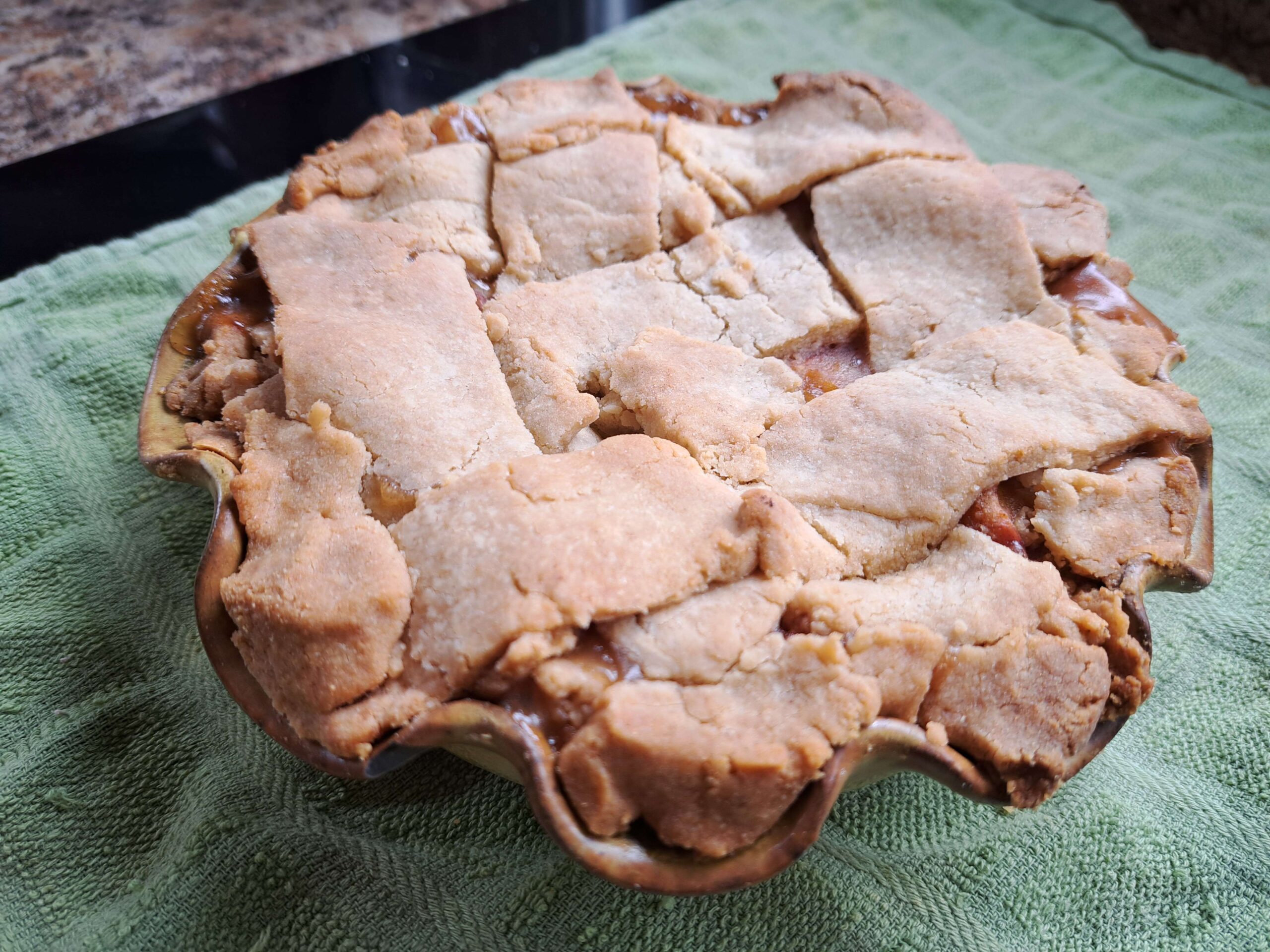
(7) Roll out the remaining pie dough and place it over the filling. Seal and flute the edges, or make a lattice crust if desired. Cut a few vents in a solid top crust to allow steam to escape.
(8) Bake at 400°F for 15 minutes. Without removing the pie from the oven, reduce the temperature to 350°F.
(9) Continue baking for 50–60 minutes. If the crust begins to brown too quickly, cover the edges with aluminum foil or a pie-crust shield.
(10) The pie is ready when the crust is golden and the filling is bubbling visibly, including near the center. Do not remove it before the filling begins to bubble, as this helps ensure that it thickens properly.
(11) Allow the pie to cool to at least room temperature before slicing so the filling has time to set. Serve it slightly warm with vanilla ice cream, or chill it overnight for a refreshing summer dessert.
This is not a quick pie. The individual steps are easy and quick, but the whole pie takes time to come together. Ripe peaches tend to be very juicy, and letting them drain in the refrigerator overnight greatly improves the filling. Then when you get to baking, the pie needs a solid hour in the oven to bake all the way through.
Then there's the whole question of whether or not to peel the peaches. I have made the pie both ways - with peach skins, and without. If you leave the skins on, it creates a more rustic pie. Peeling the peaches is the more traditional route.
Is it worth it? Absolutely! There is no replacement for a good peach pie in season. And fortunately, there are some tricks when it comes to preparing the peaches.
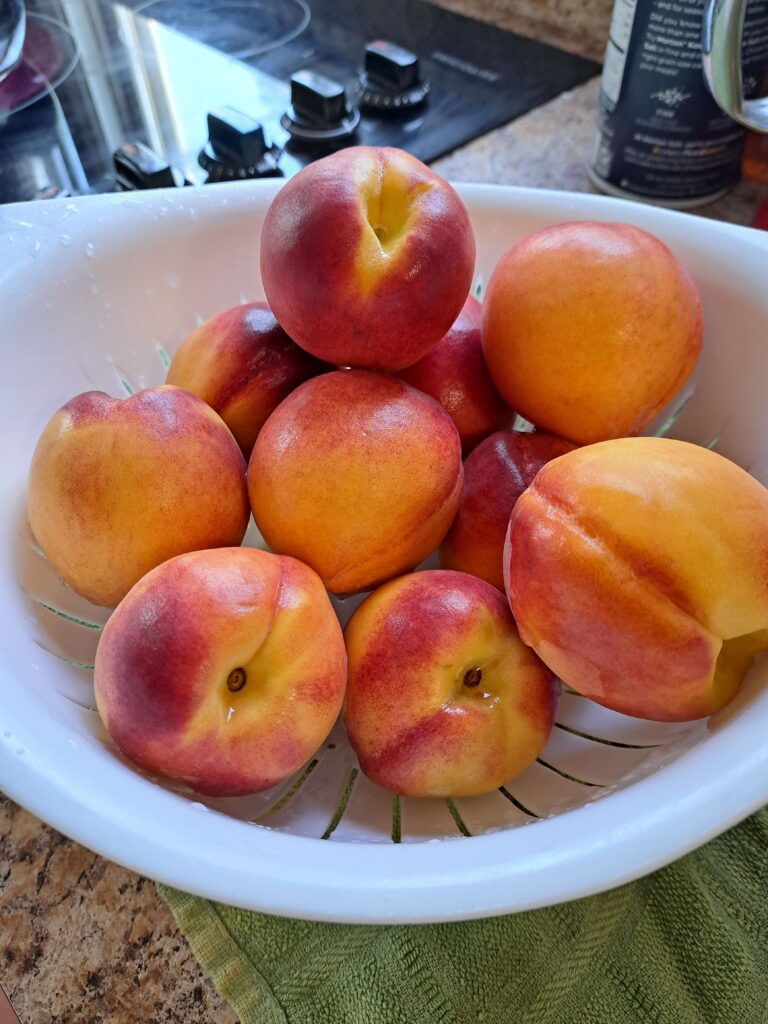
If you are using fresh peaches, you want them to be fully ripe. Read: just a little bit soft. They should have a small amount of give to them when you press them.
You don't want them to be squishy, because that will make them harder to peel and cut. But you don't want them hard either, because that will also make them more difficult to peel and their flavor will be less pronounced.
A nice deep dish pie takes a lot of peaches, and you don't want to peel all of them by hand! Fortunately, there's a quick hack: blanching.
Blanching is the process of dipping something in boiling water, and then cold water. The rapid change in temperature will make the peach skins fall right off.
To start with, put a stock pot of water on the stove on high heat. You need to bring it to a boil. You will also want to have a stock pot or large bowl of ice water on hand.
While your water is heating up, score your peaches. You want to make a nice big X in the skin of each peach. I like to center the X on the bottom of the peach, and make sure the cuts extend at least half way up the sides. A bigger cut makes the blanching process more effective. Don't cut deeply into the fruit itself - just do a shallow cut through the skin.
When the water is boiling, put the peaches in 3 at a time for 2-3 minutes. Do the peaches in small batches. If you want to do a large batch - say, all of your peaches at once - you will need to leave them in for significantly more time to achieve the same effect.
At the end of the 2 minutes, take the peaches out, and put them in the ice cold bath.
After the peaches have had a minute in the ice water, their skins should slide right off. If there are any little bits of skin still sticking, they can be removed with a peeler as normal. But you should be able to do most of the peeling with your hands!
The challenge with any fruit pie is making sure the filling is not too soupy. If there is too much juice, the filling won't hold together in a pleasing way, and will just spill out the sides of every slice as soon as you try to slice or serve it.
The solution to this issue is to drain your peaches. Assuming your peaches are slightly soft, they shouldn't need any extra help in draining. You can slice them up, and then leave them in a colander (with a bowl underneath, of course!) on the counter for a few hours, or the refrigerator overnight. The extra juice will drain, leaving you with perfect pie peach slices.
If you have slightly underripe or hard peaches, then you may want to include some sugar to macerate the fruit and help it release those juices. Put 3/4ths a cup of white sugar on your sliced peaches, along with several dashes (read: a tablespoon) of lemon juice. Allow them to drain as described above, and then proceed with the recipe as written.
A good peach pie does not require any unusual equipment or ingredients, but the right basics make the process easier. Below you will find the pie plates, brown rice flour, sugar, and spices I recommend for making a beautifully baked gluten-free peach pie with a juicy, flavorful filling.
Unfortunately not. Many fruit pies call for wheat flour to help thicken the filling, and pie crusts are also usually made from wheat (and wheat contains gluten).
That said, by swapping out brown rice flour in the filling and using a gluten-free crust, you can enjoy a gluten-free pie that is just as delicious as the regular glutenized ones!
Not necessarily. This is a matter of personal taste. The peels will add a little texture and - depending on your peaches - may change the flavor a little.
Leave the peels on for a more rustic pie; peel your peaches for a more "expected" peach pie experience.
Three steps:
For more details, read the recipe notes.
Ripe and slightly squishy.
Choose ripe peaches that yield slightly when gently pressed but are not so soft as to bruise or fall apart under pressure. Hard peaches will have less flavor and can be difficult to peel, while overripe peaches may become mushy and release too much juice.
No. Blanching is only necessary if you want to remove the peach skins. Score an X through the skin, place the peaches in boiling water for two to three minutes, and then transfer them to ice water - the loosened skins should slide off easily.
For more information on blanching, check the recipe notes.
The filling should be visibly bubbling before you remove the pie from the oven. Bubbling indicates that the filling has become hot enough for the flour and fruit juices to thicken properly; afterward, let the pie cool to at least room temperature before slicing.


Peaches have been cultivated by humans for thousands of years. Native to China, these members of the rose family have been grown (and eaten) since at least 7500 BC, according to archaeological evidence.[source] Over time, peaches traveled west through Central Asia to Persia, an association preserved in their botanical name, prunus persica. From Persia, they reached the Mediterranean world during the final centuries BC and eventually spread throughout Europe.
Spanish explorers and colonists brought peaches from the Old World to the Americas during the 1500s. By the early to mid-1600s, Native American communities were cultivating peaches and sharing their pits through established trade and social networks across the Southeast and beyond. Peach trees flower early and thrive in warm climates, making them particularly well suited to much of the South. They grew so readily that some have described them as spreading like weeds.[source]
In 1995, the peach was declared the official state fruit of Georgia, formalizing an association that had developed over more than a century. Georgia has never been the nation’s leading peach producer, nor have peaches formed the backbone of its agricultural economy. Instead, the state earned its reputation by developing successful new varieties and finding innovative ways to market and ship them across the country. Because Georgia’s peaches are also among the first domestically grown peaches to reach supermarkets each summer, they came to occupy an outsized place in the public imagination - earning Georgia the nickname "the Peach State" long before the peach received its official designation.
Peaches were common in Georgia long before it became a state, but they were not a major commercial crop during the antebellum period. Cotton dominated Georgia agriculture, while peaches were generally grown for local use and given relatively little economic value. The idea that Southern fruit growing could become a profitable industry was sometimes dismissed: Northern growers already controlled the established fruit market, while Southern farmers had neither a dependable market of their own nor an effective way to transport delicate, highly perishable fruit over long distances.[source]
And most importantly, why bother with a difficult-to-transport crop like peaches, when cotton was doing so well?
That said, there were a few early attempts. Georgia peaches reached New York as early as 1858, demonstrating that a Northern market existed.[source] Nevertheless, shipping them remained difficult and expensive, and there was not yet a concerted effort to turn peach growing into a major industry.
After the Civil War, however, Georgia's landowners faced an uncertain economic future. The cotton economy had been built upon slavery, and emancipation left them searching for new crops and new ways to make their land profitable. Fruit growing began to attract particular interest among affluent farmers, nurserymen, and advocates of scientific agriculture. For those who imagined a modern and prosperous "New South," the familiar peach took on new significance: with improved varieties, reliable transportation, and access to distant markets, it might become a valuable commercial crop.

One challenge stood in the way: peaches are delicate and highly perishable. Unlike apples, they could not easily withstand a long journey to market. That began to change in the 1870s, when Georgia horticulturist Samuel Henry Rumph developed the Elberta peach.
Large, attractive, and unusually firm, the Elberta peach could survive transportation better than many earlier varieties. In 1875, an experimental shipment reached New York in good condition and sold for an impressive price. It was proof that Georgia peaches could reach - and succeed in - the lucrative markets of the North.
Rumph then helped turn that experiment into an industry. He sold Elberta peach trees to other orchard owners and worked to improve the refrigerated railroad cars used to carry peaches over long distances. With a durable new variety, expanding rail connections, and refrigeration to slow spoilage, Georgia growers could finally send their fruit north in significant quantities. The Georgia peach was on its way from a locally grown fruit to a nationally recognized product.[source]
Arriving at the beginning of May, Georgia peaches became a hallmark of summer - an eagerly anticipated taste of warm weather. Growers built upon those appealing associations until the peach became part of Georgia's public identity. In 1922, Fort Valley, just eight miles from Samuel Rumph's hometown of Marshallville, held its first Peach Blossom Festival. The celebration was a spectacular success, reportedly drawing as many as 40,000 visitors. According to the City of Fort Valley, the festival was discontinued after 1926 because the crowds had grown too large for the community to accommodate. By then, however, the publicity had served another purpose: in 1924, the surrounding area was incorporated as Peach County, the last new county formed in Georgia. The festival tradition was revived in the 1980s, and Peach County continues to host the Georgia Peach Festival today.[source] Across the state, meanwhile, the peach appeared in advertising, festivals, tourism campaigns, music, artwork, souvenirs, and even on Georgia license plates.
Nowadays, California grows more peaches. But no other state created such a powerful cultural story and image around the fruit. When Georgia declared the peach its official state fruit in 1995, the law did not create that association; it simply recognized a cultural phenomenon already more than a century in the making.
Georgia’s official state dessert, however, is not peach pie. Georgia chose peach cobbler. The state that ultimately laid claim to peach pie was - perhaps unexpectedly - Delaware.
In 1875, when Samuel Rumph sent his first shipment of Elberta peaches north, he was competing against the fruit-growers of Delaware. At that time, Delaware was the leading producer of peaches in the United States, producing and shipping 6 million baskets at its peak.[source]
That 6 million figure is from the bill which made Peach Pie Delaware's State Dessert, in 2009. A more contemporary account - the proceedings of the American Pomological Society in 1877 - put the number of baskets shipped from Delaware and Maryland together at 7-8 million baskets.[source] We don't know exactly how big a Delaware peach basket was, and we don't know exactly what the breakdown was between Delaware and Maryland. But given that Delaware was the larger peach producing state, the 6 million basket figure isn't unreasonable. And even with a conservative estimate of a half-bushel (approximately 24 pounds), that would put their peach production at 72,000 tons - more than Georgia or South Carolina (the 3rd and 2nd biggest peach producing states in the country now) produce today.
Delaware's peach orchards owed their success to two things: local horticulturalists had done a great deal of work with various grafting techniques (specifically "budding") resulting in consistent fruit quality, and Delaware had the riverways - and later railroads - to take their fruit crop up to the big cities like Philadelphia and New York.[source]
By the 1890's, there were over 4 million peach trees in Delaware, and the peach blossom was adopted as Delaware's state flower.[source] In the words of a journalist of the time, R. J. Burdette, speaking about Middletown, Delaware at the height of the peach industry:
When the peach season is at its height Middletown never rests and never goes to bed, but spends its time in shipping peaches to an eager and peachless world.[source]

But tragically, the 1890's were also the beginning of the end for the Delaware peach industry. After decades of growing their peach orchards ever larger, the trees were hit with two diseases known as the "peach yellows" and "little peach," respectively. Both diseases affected the quality of the fruit, and either killed the tree, or required it to be destroyed to stop the spread of the disease.
Between the disease and the slow exhaustion of the soil from decades of peach-growing, the peach industry in Delaware shrank. By the 1920's, there were only 300,000 peach trees left in Delaware. Fruit growers switched to other, more reliable, fruit crops, and Delaware's peach industry became a footnote in history.
In 2009, the peach pie was made the state's official state dessert not because peaches are meaningful to Delaware's economy in the 21st century, but to commemorate their heyday in the 19th century. And, because, in the words of the school children who pushed for the bill in the first place, peach pie is "delicious, gooey, good anytime of the day, and easy to make fresh." Yes, they got the word "gooey" into official legislation. Well done.
Of course, when the hot days of summer come around in Illinois, we aren't waiting for Georgia or Delaware peaches, but the sweet peaches of Southern Illinois. Those local peaches are always the juiciest and most fragrant, and arrive sometime around July. Around here, the local supermarket always carries Eckert's Farm peaches but there are many peach orchards in the hills of southern Illinois, and have been since the 19th century.
A ripe peach is already nearly perfect on its own: fragrant, dripping with juice, and best eaten over the sink. But when peach season arrives and there are plenty of peaches on the counter, some of them are inevitably destined for pie.
This deep-dish peach pie makes the most of that brief summer abundance. The peaches are brightened with a little orange and ginger, then piled generously into a buttery gluten-free crust and baked until the filling bubbles and the pastry turns golden. Serve it warm with vanilla ice cream, or let it cool completely for firmer, neater slices. Either way, this is the pie to make while the summer peaches are here.
Deep-dish rum-vanilla custard pie is pure, unapologetic decadence. Rich custard, flavored with dark rum and real vanilla, is speckled with chocolate chips and baked inside a buttery gluten-free crust.
The creamiest custard pie you will ever taste, in a gluten free crust. Enjoy warm from the oven, or chilled the next day.
Think pumpkin, warm spices, custard, and a dollop of whipped cream - isn't that the taste of fall? This gluten free pumpkin pie recipe will let you conjure that fall feel any time of year!

